 English
  English
 Views: 500 Author: Site Editor Publish Time: 2026-07-14 Origin: Site
In 2026, one of the hottest products in the AI hardware field will no longer be just a mobile phone. Rather, they are AI glasses.
From real-time translation, AI photography to navigation, conference assistants and voice interaction, more and more manufacturers are accelerating their efforts to enter the AI glasses market.
However, many people fail to realize that:
Compared to mobile phones, AI glasses are actually more prone to "overheating".
This is because they are closer to the human body.
I. Why are AI glasses less capable of dissipating heat compared to mobile phones?
When a mobile phone gets hot, it's at most "scorching to the hand".
But AI glasses are different.
It directly comes into contact with:
The temples
The bridge of the nose
The area near the ears
If the local temperature gets too high, the user will feel significantly uncomfortable.
More importantly:
The internal space of AI glasses is even smaller than that of a mobile phone.
But it has to accommodate:
AI chips
Cameras
Batteries
Display modules
Wireless communication modules
This means:
Power consumption is increasing, but there is almost no space for heat dissipation.
II. The more powerful the AI function is, the greater the heat dissipation pressure becomes.
Nowadays, many AI glasses incorporate the following features:
Real-time translation
AI object recognition
Video recording
AI assistan
AR display
Behind these features, continuous computing is required by the chips.
And continuous computing means:
Continuous heat generation.
The problem is:
AI glasses cannot be equipped with fans like computers.
Nor can they increase the heat dissipation volume like large equipment.
Therefore, the industry has begun to rely more on:
Ultra-thin heat diffusion materials.
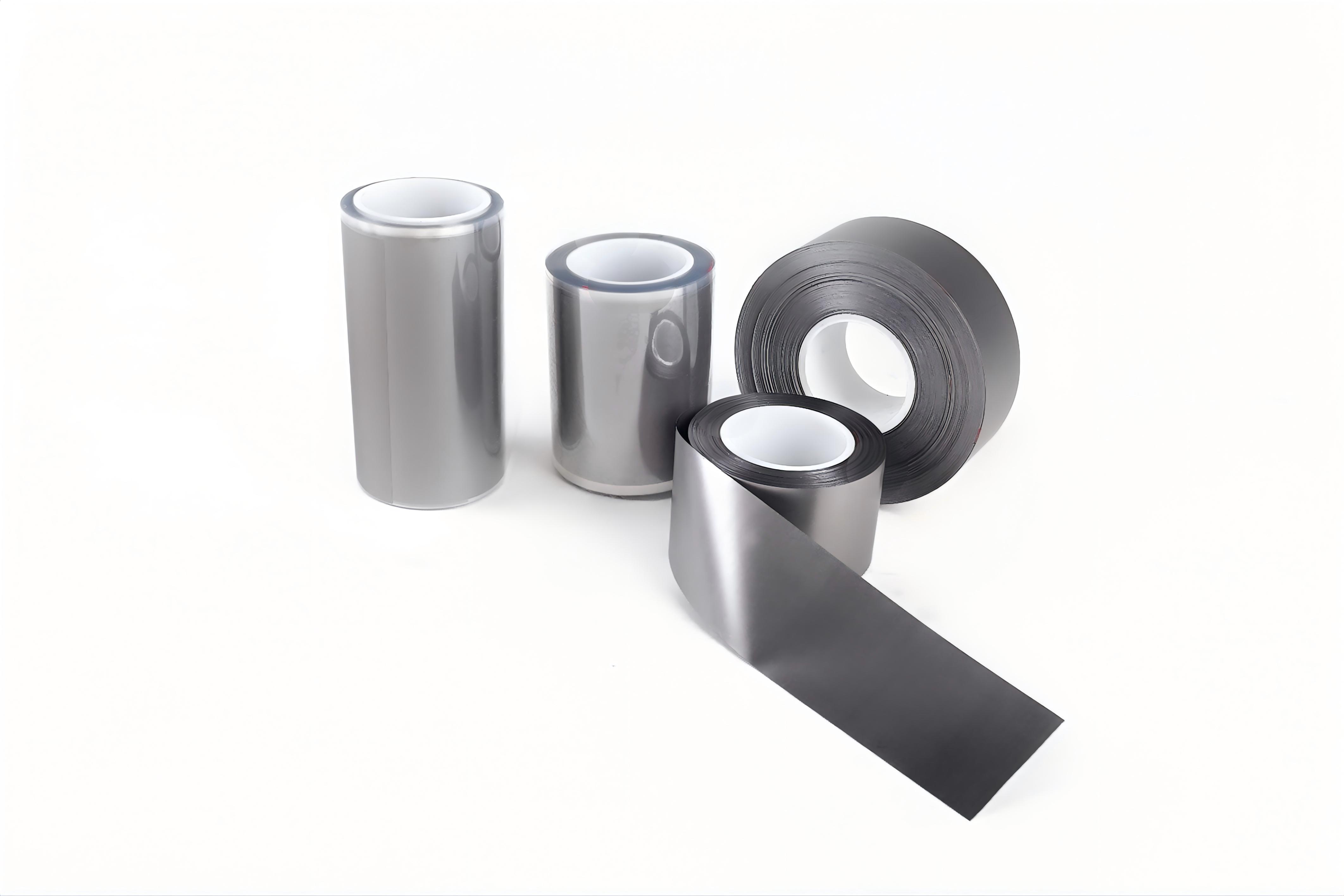
And the most widely used one is graphite sheets.
III. Why are graphite sheets particularly suitable for AI glasses?
Graphite sheets are becoming an important heat dissipation solution for AI glasses, and the main reasons are four.
1. Ultra-thin
The internal space of AI glasses is extremely limited.
Traditional metal materials often:
· Take up space
· Increase weight
However, the thickness of graphite sheets can be at the micron level.
It hardly affects the structural design.
2. Lightweight
Glasses are very sensitive to weight.
Even a few grams of weight increase will significantly reduce the wearing experience.
Graphite sheets are lighter than traditional metal materials and are more suitable for wearable devices.
3. Capable of fitting complex structures
The internal structure of the AI glasses is highly irregular.
While graphite sheets are flexible and can fit:
Curved areas
Earpieces
Edge of the mai board
This is crucial for heat dissipation.
4. Strong heat diffusion capability
The greatest advantage of graphite sheets is:
The ability to conduct heat laterally.
To put it simply:
It can quickly spread out the local hotspots.
The benefits of this are:
Reducing local high temperatures
Improving the temperature sensing performance during wear
Enhancing the stability of the chip
This is extremely important for AI glasses.
IV. Domestic Heat Dissipation Materials Are Entering the AI Hardware Supply Chain
With the rapid development of AI hardware, the market's demand for high-performance heat dissipation materials is also increasing.
Especially in the following aspects:
Ultra-thinness
High thermal conductivity
Complex structure fitting
Long-term stability
Ordinary materials can no longer meet the requirements.
At present, many domestic enterprises are also continuously focusing on the development of high performance graphite sheets.
For example, Dasen Technology has been continuously investing in research and development in areas such as artificial graphite sheets and electronic thermal management materials, and its related products have been applied in scenarios such as consumer electronics and smart devices.
Under the trend of AI hardware constantly pursuing lightweight and high performance, domestic thermal management materials are also encountering new opportunities.
V. Why is "thermal diffusion" more necessary in the AI era?
In the past, the cooling logic for many devices was:
To conduct the heat away.
But AI devices are different.
AI computations continuously generate high heat.
Therefore, the industry now pays more attention to:
How to prevent the formation of hotspots.
Because what really bothers users is not the overall high temperature. Rather, it is:
A certain area is extremely hot.
And what graphite sheets are best at is:
Controlling the heat source.
Ⅵ. Graphite sheets are expanding from mobile phones to more AI devices.
In the past, graphite sheets were most commonly found in:
Mobile phones
Tablets
Laptops
But now, their applications are expanding rapidly.
Especially in these small and high-power consumption devices:
AI glasses
AR/VR devices
Wearable products
AI headphones
Edge computing terminals
The reason is simple:
The smaller the device, the more it relies on heat diffusion capabilities.
VII. Future Trends: AI Hardware Competition Will Ultimately Turn into Heat Management Competition
Many people believe that the future of AI hardware will be determined by:
Function
Computing Power
Battery Life
However, there is a hidden competition that is becoming increasingly important:
Heat Management Capability.
Because:
Even the most powerful AI functions will fail if the temperature cannot be controlled:
The chip will reduce its clock speed.
The battery life will decrease.
The user experience will deteriorate.
And the importance of the graphite sheets will continue to increase.
Because it doesn't merely address "heat dissipation". Rather, how to ensure that heat flows more evenly within a very small space.
The explosion of AI glasses is not merely an intelligent hardware trend.
Behind it, it actually drives the entire cooling industry to upgrade.
And the reason why graphite sheets are gaining more attention is not because they are "high-end".
Rather, it is because:
In the AI era, miniaturized devices increasingly rely on heat dissipation capabilities.
In the future, whoever can solve the heat problem will be the one who can truly unleash the performance of AI hardware.